The edges where Chaos lives
I sat on a harbour wall imagining stepping out onto the water. Peter could walk on it. I couldn't. That gap — between what he knew and what I could only imagine — is the same one most of us are living in right now.
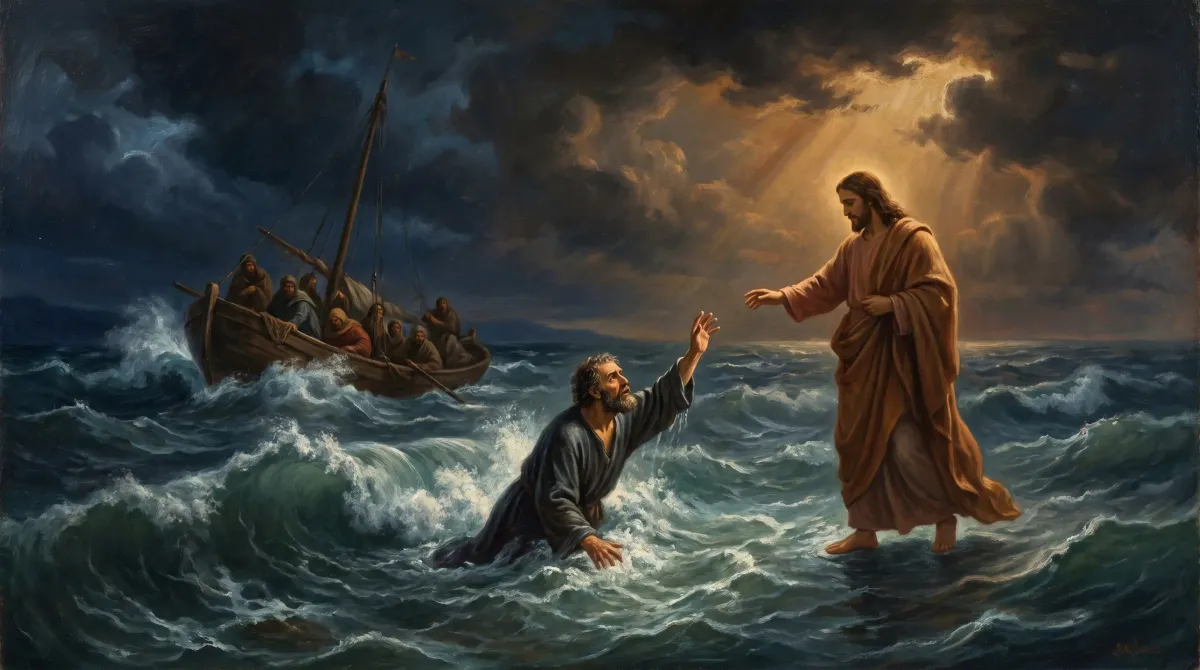
Yet these are but [a small part of His doings] the outskirts of His ways or the mere fringes of His force, the faintest whisper of His voice! Who dares contemplate or who can understand the thunders of His full, magnificent power?
— Job 26:14 (AMP)
I recently stepped out of comfort into chaos.
A step Peter once took when he saw Jesus walking on the water past their boat. That step wasn’t onto a glass-like surface. It was out onto a storming swirling sea. From a boat 'battered by the waves; for the wind was contrary'. Yet out he stepped, onto waves that smashed into the boat, drenching him in salt spray.
Not far from where I live, there’s a small fishing harbour — Kalk Bay. The harbour wall protects a small area where the fishing boats are anchored. Whilst on the way home, I’d occasionally exit the train a few stops early, to walk the last stretch home. The path would take me along the coast line past the harbour.
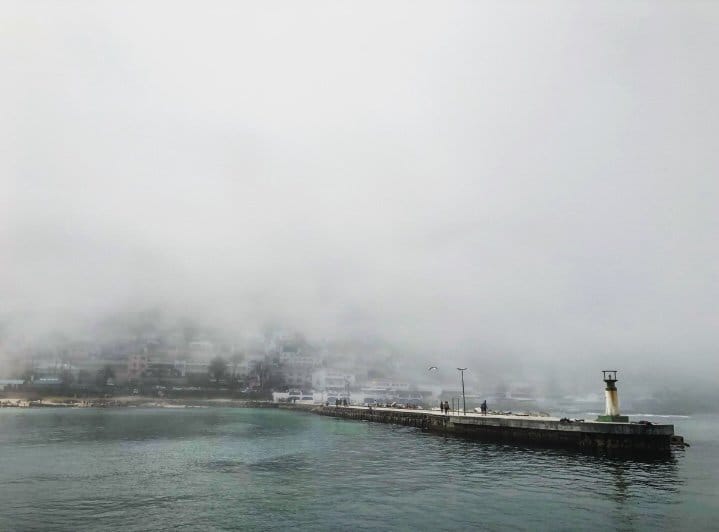
One day, my soul matching the relentless south easter and stormy sky, I arrived at the harbour and decided to take a walk out onto the wall. On the one side of the wall was this relative calm. The fishing boats rocked to and fro against their tether lines. But on the sea side of the wall, the water had this dark, angry swirling restlessness. The waves crashing against the wall sending up a spray that the wind caught and carried off.
I sat on the end of the wall just across from the ‘Brass Bell’ — a local bar and restaurant. Looking down at the water, I started imagining stepping out onto it, walking across to the Brass Bell. And in that moment, I understood what Peter faced and, with clarity, what he actually did. And with the same clarity, what I could not have done.
I could not see that water ‘hardening’ under my feet as I stepped out. So there I sat — the wall solid beneath me, the sea untameable before me, and the distance between those two things suddenly very clear.
Earlier in the same chapter as the verse I quoted in the opening, Job had been describing the One whose power I had just brushed against. ”HE stretches out the northern skies over emptiness and hangs the earth upon nothing.” And then, almost as an aside — the mere fringes of HIS force.
Pause there.
Stretching out the universe — emptiness, suns, planets, and many unknowns — is at the fringes of HIS power. The outskirts. What’s at the centre, then? WHO is this we serve?
And HE called Peter out onto that stormy sea as HE stood out there, standing on it.
Read the rest of that story carefully. Peter takes that step out of the boat. He walks on the water. Then he sees the wind. He becomes afraid. He begins to sink. And the cry that leaves him — "Lord, save me!" — is three words long, the prayer of a man who has stopped believing he can.
Jesus reaches out immediately, and catches him. Not after a lesson. Not after Peter promises to do better. Immediately. The One whose ‘fringes hold up the universe’ was right there, ready the whole time.
That is what I had been turning over on the harbour wall. Not Peter's first step — Peter's sinking. And the hand that reached out faster than he could sink.
I sat on that wall a long time. Around me, chaos: the south-easter hammering, the spray, the dark restless water on the seaward side. The dictionary is precise about chaos — complete disorder and confusion; behaviour so unpredictable as to appear random, owing to great sensitivity to small changes in conditions.
How could I set my foot onto that chaos with confidence? The kind of confidence Peter had as he stepped out of the boat. This question is the same as fundamental faith. How do we firmly trust what we cannot ‘see’?
We are not built for open water. Every instinct pulls us back toward terra firma.
Even my recent step — if I'm honest — carried more unknowns than I'd like to admit.
We moved back to Cape Town two weeks ago. Familiar city, familiar friends, familiar coastline. On paper, a return to known.
What returning after 20 years away actually meant: different people, different climate, different church, different working setup, a different rhythm to days that used to set themselves. Unfamiliar familiarity. Predictability and comfort traded for their opposites in a single drive south.
Then, one week in, a Level 8 storm hit the Western Cape. Roofs torn off. Trees down. Roads washed out. The Breede River pushing nearly two thousand cubic metres a second. Ten dead. Over a hundred thousand people affected. Communities cut off — no road, no electricity, no signal.
The chaos of weather has its own honesty. It announces itself in megajoules. It rearranges landscapes, plans, and lives in hours. The South African Weather Service called it disruptive rainfall. The people on the ground called it the day the roof came off.
One chaos announces itself in megajoules. The other arrives as a notification.
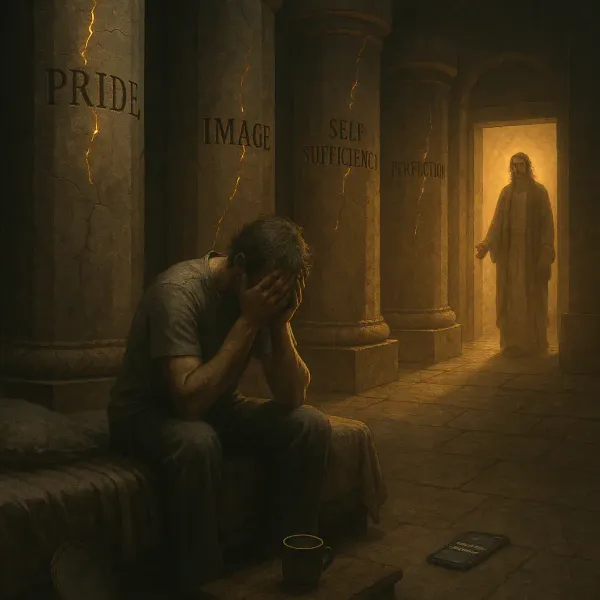
Everywhere I go — rural villages in Africa, airport lounges, family dinner tables — I see humans connected and simultaneously alone. We carry a world inside a screen, six inches from our face. It knows our habits before we do. It surfaces our fears, confirms our biases, monetises our loneliness — and we scroll on, because the next thing is always one flick away.
The algorithmic age doesn't announce itself. It doesn't tear roofs off. It simply, quietly, begins to think for us. To choose for us. To tell us who we are, what we want, what to fear. And we let it — because it's frictionless, and friction is uncomfortable.
This is a different kind of drowning.
Peter sinking in the storm could feel the water closing over him. We often can't feel what's closing over us at all — the algorithms are insidious.
And, here’s the truth of our lives - ‘we see through a glass darkly’. What we think we see so clearly, is actually a dark cloud of unknowing.
Years ago, that truth landed for me with a gut punch.
I was working a big project at work. Deadlines looming, pressure to deliver constant. Someone had just ordered in pizza. We’d be working through lunch again.
A gnarly problem was staring me in the face. I was all in on figuring it out. The rest of the team was in the meeting room discussing strategies to meet the deadline. We were on the back foot.
The phone rang. I picked up, expecting it to be a call for someone in the meeting room. It was my wife. She started, “D-o-n-’t p-a-n-i-c!”. That got my attention. “Daniel’s just been hit by a car. You need to get to the hospital. Now!”.
The deadline, the gnarly problem, the focus to solve it evaporated in a nanosecond. Nothing about work mattered one iota. My attention was fixed on getting to the hospital. That dark cloud had unknowingly hit me head on. As did two years of in-and-out-of hospitals. Our innocence was gone forever — stuff happens and we cannot reliably predict, nor stop it.
So, what does that leave us with?
Insecurity?
Chaos?
Life has taught me that we need to live life as it IS, not as it ‘should be’. And the IS, is that we cannot control things outside ourselves. We try, but vainly.
And how do we do this ‘live life as it IS’ thing?
We need an anchor.
And that anchor is …
We have this hope as an anchor for the soul, firm and secure. It enters the inner sanctuary behind the curtain, where our forerunner, Jesus, has entered on our behalf, having become a high priest forever...
— Hebrews 6:19–20
HE — the One whose fringes hold up the universe, and whose centre we have not yet seen — has already gone ahead. The anchor is HIM, before we knew we'd need it.
Stuff happens. We cannot reliably predict it, nor stop it. The work is not to harden the water under our feet.
The work is to keep setting our faith and hope in HIM no matter what. Present tense, continuous. HE is in control, and we no longer have to try to be.