The Other Country
In an age where nostalgia is served to us on cue, it’s easy for yesterday to become the judge and today to be found guilty. This post is a threshold reflection — leaving KZN, returning to Cape Town, and choosing presence over comparison.
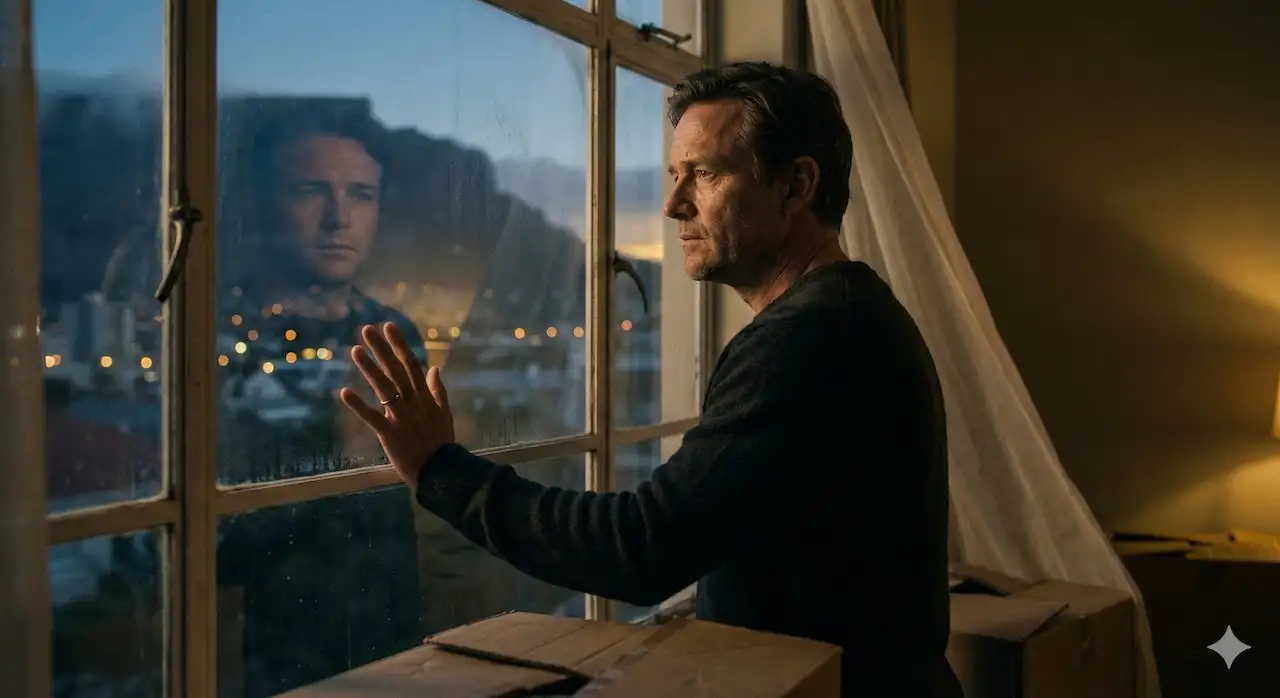
I’m moving back to Cape Town after twenty years in KwaZulu-Natal, and it feels bigger than boxes. The first thing I’m learning about this move is that it isn’t a return—it’s a crossing. I’m packing up a life in KZN and I can feel, in my body, that something has ended.
What makes it tender is that leaving is never only logistical. It’s a kind of visibility—naming out loud that a season is over, that I’m stepping into what I don’t yet understand, and that I’m doing it without the old bravado that used to make the unknown feel like play.
And with the naming comes the reality of a tearing apart. Friendship, familiarity, the small unspoken rhythms that have held me—favourite roads, familiar voices, regular gatherings, the shorthand of belonging—don’t pack neatly into boxes. Some things can only be carried as grief, and even that feels exposed, because it admits how much this people and place have mattered.
Cape Town, the first time around, was bright. Sun in my face, wind in my hair, adventure in my bones. I learned my way around myself there—through discovery, friendship, risk, and the kind of freedom that makes you think the world is mostly safe if your intentions are good.
But I’m not under any illusion that I’m going back to that Cape Town, or that younger man. The city has moved on, and so have I. Twenty years in KZN had a way of changing the weight of things.
That’s why I can feel the old question hovering at the edges:
Why were the former days better than these?
It’s a question that sounds like reflection, but it often arrives as a kind of refuge—a way of backing out of the present before the present has even had a chance to speak.
Qohelet cuts through it with surgical precision:
“Say not, ‘Why were the former days better than these?’ For it is not from wisdom that you ask this.”
Ecclesiastes 7:10 (ESV)
He isn’t scolding us for remembering. He’s exposing a posture.
Because once the past becomes the judge, the present is always found guilty.
The former days in Cape Town really were memorable. The challenges then were real, but they mostly weren’t the kind that rearrange your insides. That kind of weight came later. And now, in KZN, I've been comfortable for the longest time. So when Ecclesiastes warns me not to ask, “Why were the former days better than these?” it’s not telling me to deny the brightness of yesterday.
It’s telling me not to build a life where yesterday becomes the standard and today becomes a disappointment before it’s even been received.
The past can be a gift, but it makes a terrible god.
And in an algorithmic age, nostalgia doesn’t even have to be chosen—it gets served. "Highlights", “Memories”, “Your year on …”, old photos, old versions of ourselves, resurfacing on cue. The past is edited into something smoother than it was, and the present is reduced to whatever feels most lacking. Without noticing, we start living on comparison—scrolling yesterday’s certainty against today’s unfinishedness.
Which is another reason the present can feel so exposing. The past lets you rehearse a story you already understand. The present asks you to be seen while you’re still becoming.
And that brings me back to KwaZulu-Natal—the season that changed my centre of gravity. Twenty years is long enough for a place to get into your bones. It has been a transformative journey: a parched desert and deep wells, a time of great loss and great gain. The kind of formation one doesn’t choose, but you can choose how you carry it.
I’m clear-eyed about something: that season has come to an end. Not because everything is resolved, not because the story is neat, but because I can sense the completeness of it. What was necessary is now done. The pillar of fire has moved. It’s time to respond. I don’t mean that in a mystical, unaccountable way. I mean I’ve discerned—slowly, soberly, and with responsibility—that staying would now be a refusal to honour what this season has done in me, and what it is no longer doing.
Which means I’m stepping into what I don’t know. There’s possibility in that, but there’s also a sober awareness I didn’t have at twenty-five, even thirty-five. The wild, carefree “that won’t happen to me” attitude is long gone. I know, deeply and personally, that hard things happen. I know too that He does not leave or forsake.
13 All these died in faith, without receiving the promises, but having seen them and having welcomed them from a distance, and having confessed that they were strangers and exiles on the earth. 14 For those who say such things make it clear that they are seeking a country of their own. 15 And indeed if they had been thinking of that country from which they went out, they would have had opportunity to return. 16 But as it is, they desire a better country, that is, a heavenly one. Therefore God is not ashamed to be called their God; for He has prepared a city for them.
Hebrews 11:13–16 (NASB)
And maybe this is where Hebrews 11 starts to make sense in my own skin. It speaks of people who admitted that they were strangers and exiles on the earth—people who refused to organise their lives around what they’d left behind. They weren’t trying to get back to an old country; they were learning to long forward for a better one.
That language has always sounded lofty until you actually live it. Until you realise that faith sometimes looks like staying tender while you become un-homeable, learning to belong to God more than you belong to any particular place, season, or version of yourself. This isn’t self-erasure. It’s a refusal to let any one season, or any one version of me, become my identity’s final address.
One of the things I’m noticing, as I speak this move out loud, is how much transition is bound up with visibility. Not the performative kind—announcements and updates and curated certainty—but the quieter exposure of admitting: I don’t know what this will look like. There’s a vulnerability in that, especially when you’ve lived long enough to know that outcomes aren’t guaranteed.
Megan Macedo wrote something that lodged in me: the fear isn’t always that no one will see—it’s that one person will see. That someone will witness your awkward beginning, your unfinished plan, your unpolished next step. That kind of being seen can feel like risk—especially when nostalgia is offering you a safer script.
But maybe that’s the lie I’m unlearning: that visibility is a solo endeavour, that you either hide completely or you “put yourself out there” with a clenched jaw and a brave face. It's neither. In the Kingdom, we don’t cross thresholds alone. We are members of one body. We strengthen what is weak by sharing the load—offering presence more than advice.
So I’m looking for something simple in this next chapter. Not a grand reinvention. Not a triumphant return. Just a faithful beginning—with at least one or two people who will ‘come’, who will stand with me while I find my footing again.
That’s not merely emotional support; it’s ordinary New Testament life. The Scriptures assume a people, not a spiritual soloist—yet not the crowd, not the machine, not the institution-as-saviour. Just the ordinary grace of saints who show up, speak truth with gentleness, and point you back to Christ. We are “fellow citizens” and “members of God’s household”. We are exhorted to encourage one another day after day, because drifting is real, fear is real, and isolation is not strength.
And so, as I move back to Cape Town, I want to practise a different posture. I want to meet the present on its own merits, without letting yesterday sit in judgement. I want to honour what was, without trying to resurrect it. I want to step into the unknown with sobriety, yes—but also with hope that is not naïve.
Because Hebrews is true, the deepest story isn’t Cape Town or KZN. It’s that we are strangers and exiles here, learning to long forward for a better country—a heavenly one. And the wonder is not that we feel homeless at times; the wonder is that God is not ashamed to be called our God. He has prepared a city.
For now, that means I travel light. I hold my memories with gratitude, not governance. I keep my eyes lifted—not to romanticise the future, but to remember Who I belong to. And I take the next faithful step, trusting that the God who ends seasons with mercy also meets us at the edge of the next one.
My first commitment in Cape Town is to plant myself among a local body and a small circle of true companions—not as overseers, but as witnesses and friends who keep me close to what’s true when fear, nostalgia, or pride try to write the script.
And if I had to put a soundtrack to this threshold, it would be Burlap to Cashmere’s "The Other Country".